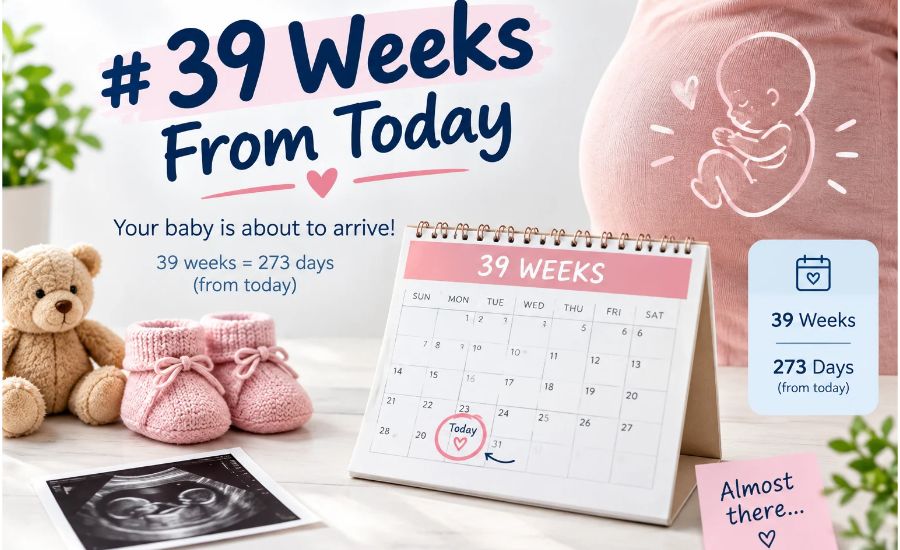
Mark your calendar: 39 Weeks From Today, October 2, 2026, lands on Friday, July 2, 2027. That gap works out to 273 days, or close enough to nine months that most people round it that way. A handful of common reasons people search this number: pregnancy tracking, personal goals, travel planning, upcoming deadlines. This piece breaks down the date itself, the quickest ways to calculate it, and practical ideas for using that stretch of time well.
Read More: What Time Was It 22 Hours Ago? A Simple Time Guide
So What’s the Actual Date?
Friday, July 2, 2027 — that’s where you land. The logic is simple: 39 multiplied by 7 gives you 273 days, and tacking those onto October 2, 2026 gets you there. One quirk worth knowing — since you’re adding a clean number of weeks, the weekday never shifts. Start on a Friday, end on a Friday. That rule holds true no matter how many weeks out you’re calculating.
Translating 39 Weeks Into Days and Months
In raw days, 39 weeks is 273, no rounding needed. Months are trickier because they don’t divide evenly into 7-day chunks — some run 30 days, some 31. Dividing 273 by the average month length (around 30.4 days) lands you at roughly 8.98 months, basically nine months minus a sliver. Think of it as three full seasons passing. Weather, routines, even your day-to-day circumstances will likely look pretty different by the time you reach that date.
Quick Ways to Calculate 39 Weeks From Any Day
No calculator required, really. Grab your starting date, tack on 273 days, done. Or use the shortcut: add nine months, then knock off two days. Testing it on October 2 — nine months forward is July 2, which already matches, so there’s nothing left to subtract in this particular case. Alternatively, your phone’s calendar app will let you flick forward week by week, or you could drop a formula into a spreadsheet that adds 273 days automatically.
Why Pregnancy Searches Dominate This Topic
Pregnancy is the number one reason “39 weeks” gets typed into search bars. A full-term pregnancy generally spans 40 weeks total, and hitting week 39 often means the baby’s development is essentially complete and ready for birth. The medical community defines “term” as anywhere from 39 weeks through 40 weeks and six days. Freshly pregnant and trying to ballpark your date? Counting forward 39 weeks gets you close, though your doctor’s ultrasound measurements will always beat an online estimate for accuracy. When in doubt, defer to your provider, not a calculator.
Your Baby’s Development at the 39-Week Mark
Picture a small watermelon — that’s roughly your baby’s size at this stage, usually weighing somewhere around 7 to 7.5 pounds. Core systems like the lungs and brain have essentially finished developing, prepping for life outside the womb. For many mothers, this phase brings exhaustion, bloating, and a strong readiness for labor to kick off. Lower abdominal pressure, cramping, back pain, and Braxton Hicks contractions are all fairly typical here. Anything that feels intense or off should prompt a quick call to your doctor or midwife.
How to Spot the Signs of Labor
Labor’s unpredictable at this stage, so it pays to know the warning signs. Watch for contractions that keep intensifying and don’t fade with rest or repositioning — that’s a strong indicator. Your water breaking is another telltale sign, whether it’s a sudden gush or a slower leak. Some people notice a blood-streaked mucus discharge too, commonly called the “bloody show.” Most hospitals want you to come in once contractions are roughly five minutes apart for a solid hour. Pregnancies vary person to person, so always check with your doctor for guidance specific to you.
Is Week 39 Officially “Full Term”?
It is, yes. Medical thinking used to place the term cutoff at 37 weeks, but updated research revealed those last couple of weeks carry real developmental weight. Babies delivered at 39 weeks generally show stronger lung function, more stable body temperature, and smoother feeding compared to earlier births. That’s largely why doctors tend to hold off on scheduled C-sections until at least this point, barring a medical reason to move earlier. Your own doctor will factor in your specific circumstances before deciding.
Turning 39 Weeks Into a Goal-Setting Window
Pregnancy isn’t the only reason people search this number. Plenty treat 39 weeks as a built-in challenge period — long enough to see meaningful change, short enough to stay realistic. Could be a savings goal, a new skill, healthy weight loss, finishing a manuscript — whatever it is, the key move is picking one target and chopping it into weekly chunks. Do that, and suddenly 39 weeks isn’t some distant deadline anymore — it’s just 39 small, doable steps in a row.
Read More: 8 Weeks From Today: Find the Exact Future Date
A Simple Framework for Breaking It Down
Setting a goal is step one; splitting it into phases is what actually makes it manageable. Try dividing your 39 weeks into three chunks of 13 weeks apiece, roughly matching a season each. Phase one: learn and get ready. Phase two: build momentum and push harder. Phase three: finish strong and tweak what’s not working. Check in at the end of each phase to review where you stand and adjust as needed. This keeps the whole thing from feeling like one overwhelming slog, since there’s always a nearer checkpoint in sight.
Stacking Up Savings Across 39 Weeks
A financial goal fits this timeline almost perfectly. Committing to a set weekly amount makes growth easy to watch unfold. Set aside $50 a week, and you’ll have banked $1,950 by week 39. Push it to $100 weekly, and that climbs to $3,900. Tailor the number to whatever actually fits your budget. Stashing it in a separate account keeps temptation out of reach. Automating the transfer removes the friction entirely — set it once, forget about it.
Using the Time to Build Better Health Habits
This window suits gradual health improvements particularly well — research backs up the idea that slow changes stick around longer than quick fixes. Start small: a 20-minute daily walk. From there, layer in strength training, stretch your walking distance, or work your way toward jogging. Better hydration and nutrition choices add up quietly over nine months too. Everyone’s starting point differs, though, so loop in a medical professional before making big shifts, especially with any existing health concerns.
Why Event Planners Love a 39-Week Runway
A long lead time like this is a gift for anyone organizing something big — a wedding, a product launch, a family reunion. Nine months of advance notice means you can lock in venues early, shop around for better deals, and dodge the chaos of last-minute planning. Early bird bookings often come cheaper too, since popular dates and vendors get snapped up fast. Keep every deadline — deposits, invitations, payments — logged somewhere the whole team can see.
Tools That Make the Math Effortless
You’ve got no shortage of options here. Your phone’s calendar app scrolls forward week by week with a swipe. Online date calculators add days, weeks, or months in a click. Spreadsheet tools like Excel or Google Sheets handle the 273-day addition with one formula. Pregnancy-specific due date calculators typically work backward from your last period or estimated conception date instead. Whatever tool you reach for, it’s worth double-checking the output against a second source.
Where People Usually Go Wrong
A few mistakes keep coming up.Starting the count from the wrong day — or forgetting to include today — throws things off immediately. Confusing weeks with months is another classic slip, since months rarely line up neatly with four-week blocks. Leap years sneak in an extra day come February, which people often forget to factor in. And for pregnancy specifically, there’s frequent mix-up over counting from conception versus the last menstrual period — know which one applies before you calculate.
Making 39 Weeks Actually Count
Nine months has a way of slipping by faster than you’d think, so a plan helps. Write the goal somewhere visible — somewhere you’ll see it daily. Log your progress and acknowledge every bit of movement forward, however small. Bring someone else into the loop — a friend or family member who’ll keep you motivated. Fall off track? Simply pick it up the following day.Little progress still beats no progress, and come July 2027, you’ll likely be glad you didn’t wait to start.
Frequently Asked Questions
What’s the exact date 39 weeks out? Friday, July 2, 2027.
How many days is that in total? 273 days.
Does that roughly match 9 months? Yes — just a day or two shy of a full nine months.
Does week 39 count as full term in pregnancy? Yes, babies born at this point are classified as full term.
Wrapping Up
Thirty-nine weeks out from today puts you squarely on Friday, July 2, 2027. For some, that date marks a new arrival in the family. For others, it’s a finish line for a goal or event they’ve been building toward. Whatever’s pulling you toward this calculation, having the exact date in hand means you can move forward with a clear plan. Put the ideas in this guide to work, and make your own 39 weeks count.