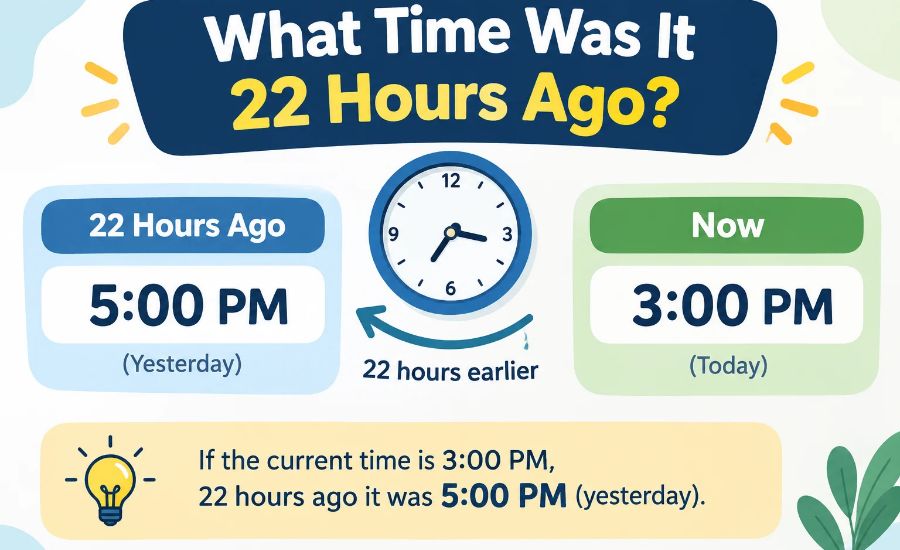
For example, assume the present day nearby time is 6:40 PM on August sixteen, 2026. Subtracting 22 hours gives:
- 6:44 PM, August sixteen − 22 hours = 8:42 PM, August 15, 2026
The calculation may be made in steps:
- 6:forty two PM minus 18 hours = 12:40 AM on August 16
- 12:40 AM minus four hours = 8:forty PM on August 15
This works due to the reality a time c programming language measures the elapsed length amongst factors. NIST defines a time interval as the elapsed time amongst sports and notes that hours and days are commonly used to precise longer intervals. (csrc.Nist.Gov)
There is also a handy highbrow shortcut. Because 22 hours is hours tons much less than 24 hours, you may first subtract one complete day after which add hours:
Current time − 24 hours + 2 hours = time 22 hours within the beyond
Using the equal example:
- 6:40 PM on August 16 − 24 hours = 6:forty PM on August 15
- 6:forty PM + 2 hours = 8:forty two PM on August 15
This method could make calculations throughout midnight less tough due to the fact subtracting 24 hours first takes you to the same clock time on the preceding calendar day. NIST defines one hour as 60 minutes and inside the destiny as 24 hours, supplying the idea for this relationship.
The same principle applies to expressions which include “22 hours within the beyond,” “22 hours from now,” and “22 hours later.” “22 hours inside the past” requires subtracting the interval from a reference point, whilst “22 hours from now” requires which include it. In every instance, the suitable starting date and time determine the very last end result.
For normal conditions which embody checking when an internet post has turned out to be made, reviewing an occasion, calculating a cut-off date, or evaluating timestamps, use the right close by time and date due to the fact the start line. If different places are involved, the relevant time area must additionally be recognized because network clock instances can range.
In easy terms, locating the time 22 hours inside the past technique subtracting 22 entire hours from the reference time. The most available shortcut is to subtract 24 hours after which to upload 2 hours, even remembering to alter the calendar date at the identical time as important.
Read More: 8 Weeks From Today: Find the Exact Future Date
What Does “22 Hours Ago” Mean?
The phrase “22 hours ago” refers to some extent in time exactly 22 elapsed hours earlier than a particular reference second. It is a period-based totally definitely completely calculation, so the cease result relies upon the start date and time as opposed to surely figuring out the preceding calendar day.
For instance, if the reference time is 6:forty two PM, subtracting 22 hours offers 8:forty two PM on yesterday:
- 6:forty PM − 22 hours = 8:42 PM the previous day
One clean way to apprehend the calculation is to apprehend that 22 hours is hours shorter than 24 hours. A whole day carries 24 hours, so you can subtract one complete day and then upload hours lower back:
- 6:forty PM − 24 hours = 6:forty two PM the day past
- 6:forty two PM + 2 hours = eight:forty two PM the day past
This shortcut is beneficial even as mentally calculating instances that go nighttime. NIST explains that factor periods represent the elapsed duration between sports, at the same time as longer periods are normally expressed by the usage of gadgets which includes hours and days.
It is vital to preserve the date in thoughts in addition to the clock time. For example, 22 hours before 6:forty PM on August sixteen, 2026 is 8:forty PM on August 15, 2026. The calculation moves backward in the middle of the night, so the calendar date changes.
The same precept applies to different expressions which include “22 hours from now” or “22 hours later.” The distinction is the path of the calculation: “22 hours in the past” moves backward from the reference point, on the same time as “22 hours from now” moves earlier.
For correct results, use the appropriate starting time, date, and relevant time sector. This is particularly important at the same time as comparing timestamps from brilliant locations, reviewing on-line interest, checking event times, or calculating closing dates.
In easy phrases, “22 hours ago” means subtracting 22 entire hours from the reference time. Because 22 hours is a lousy lot, an awful lot less than a whole 24-hour day, the end end result may additionally fall at the previous calendar date at the same time as though being as an alternative close to the specific clock time.
What Are Some Simple 22-Hour Examples?
The simplest way to apprehend a 22-hour time calculation is to art work via some extremely good beginning instances. Since 22 hours is a fantastic number of hours less than a full 24-hour day, removing it frequently yields a clock time that is close to the exact time, possibly even changing the calendar date.
For instance, the reference time is 6:40 PM. Subtracting 22 hours offers:
- 6:42 PM minus 22 hours equals 8:42 PM the day before.
A 2d example indicates that the clock time does not now have to flow into the preceding date in each scenario. Subtracting 22 hours from the start time of 1:00 AM yields:
- 1:00 AM minus 22 hours equals 3:00 AM on the previous day.
In each time, the calculation moves backward through precisely 22 elapsed hours, however the ensuing clock time and date ought to be decided from the place to begin.
Treating 22 hours as 24 hours minus 2 hours is a useful mental shortcut. First flow once more one complete day, then glide in advance through the usage of hours:
- 6:42 PM minus 24 hours = 6:42 PM
- 6:forty PM + 2 hours = eight:40 PM the day gone by
This approach may additionally need to make longer time calculations tons less complex to perform without a calculator.
Another manner to test the cease result is to matter the c programming language in tiers. For instance, from 6:40 PM in recent times lower again to six:forty two PM the day gone by is 24 hours. Moving ahead hours offers 8:40 PM the day gone by, which confirms that the very last detail is exactly 22 hours in advance.
The same approach works with any starting time. A date-and-time calculator can also subtract hours, minutes, and seconds from a delegated date and time, which is beneficial whilst the calculation needs to be precise.
Read More: What Time Was It 15 Hours Ago? Easy Time Calculator
Does 22 Hours Ago Typically Refer to the Day Before?
Usually, sure. Because 22 hours is handiest hours shorter than a whole 24-hour day, subtracting 22 hours will commonly circulate the calculation into the previous calendar date.
The particular end result is predicated upon the start time. For instance:
- On the day before today, 1:00 AM − 22 hours = 3:00 AM
- 8:00 AM minus 22 hours equals 10:00 AM on the previous day.
- 6:40 PM − 22 hours = 8:forty PM on the day prior to this
However, there may be an essential exception. When the beginning time is 10:00 PM or later, subtracting 22 hours can remain at the identical calendar date;
- On the same day, 10:00 PM minus 22 hours equals 12:00 AM.
- On the same day, 11:30 PM minus 22 hours equals 1:30 AM.
The best way to recognize that is to evaluate 22 hours with a whole day. A day includes 24 hours, so:
- 24 − 22 = 2 hours
You can therefore calculate 22 hours ago with the aid of the way of first moving again 24 hours after which transferring ahead 2 hours. For example:
- 6:forty two PM these days − 24 hours = 6:forty PM yesterday
- 6:42 PM the day before
This is an elapsed-time calculation instead of an easy rule that constantly method “the day gone by.” Date-and-time calculators use the same precept with the useful resource of subtracting a chosen huge style of hours from a particular starting date and time.
The difference is useful on equal time as checking timestamps, reviewing online interest, calculating closing dates, evaluating occasion instances, or decoding terms at the side of “22 hours ago.” The true date has to continuously be determined from the proper date and time in desire to assume.
In simple phrases, 22 hours in the past is common for the previous calendar day, except while the cutting-edge time is between 10:00 PM and midnight, when the end result falls on the same date.
What If the 22-Hour Calculation Crosses Midnight?
Subtracting 22 hours can seem complicated while the calculation passes via middle of the night, however the system remains the same. The crucial detail is to treat 22 hours as an elapsed time c language after which modify the calendar date when the calculation moves beyond middle of the night.
For example, I think the reference time is four:00 PM. Subtracting 22 hours may be calculated in tiers:
- four:00 PM − 16 hours = 12:00 AM
- 12:00 AM − 6 hours = 6:00 PM on the day past
Therefore:
- 4:00 PM − 22 hours = 6:00 PM the previous day
There is likewise a convenient shortcut. Because 22 hours is hours plenty much less than 24 hours, subtract one complete day after which add hours:
- four:00 PM − 24 hours = four:00 PM the day gone by
- 4:00 PM + 2 hours = 6:00 PM the day past
Both strategies produce the identical result. The first technique indicates precisely how the calculation movements through nighttime, while the second is regularly simpler for highbrow arithmetic.
Crossing midnight does not change the length of the c programming language. The calculation remains exactly 22 hours; best the displayed date adjustments due to the truth the result falls on an earlier calendar day. NIST describes a time c language as the elapsed period among two occasions, that is the underlying concept in this type of calculation.
This precept may be executed to any beginning time. A date-and-time calculator also can subtract hours, minutes, and seconds from a unique date and time when a completely unique result is needed.
For practical functions, the very best rule is:
- Reference time − 22 hours = genuine in advance date and time.
Read More: What Time Was It 16 Hours Ago? Exact Time Guide
Applications of a 22-Hour Time Calculation in Real Life
A 22-hour time calculation may be useful each time you need to determine whilst a few things occurred relative to a recognized reference point. It is especially useful whilst strolling with timestamps, interesting information, schedules, time limits, or occasion histories in which the original clock time is not proper now apparent.
For instance, if an activity log states that an event happened “22 hours in the past,” you could subtract 22 hours from the current timestamp to end up aware of the approximate clock time and calendar date whilst that event came about. Because 22 hours is near a full 24-hour day, the calculation may additionally moreover skip nighttime, making it essential to check the ensuing date as well as the time.
This method is beneficial for reviewing net web page hobby, utility logs, social-media timestamps, gadget information, transport updates, paintings schedules, and exclusive chronological records. NIST explains that point periods represent the elapsed period among two activities, that’s the identical principle used whilst converting an “hours in the past” declaration into a particular earlier timestamp.
A 22-hour calculation also can assist even as comparing facts from distinct structures. One platform may additionally display a precise timestamp, while some different platforms can also show relative wording which encompass “22 hours in the past.” Converting the relative time into an predicted clock time may want to make it less tough to region every information on the equal timeline. However, the assessment needs to apply the same time area and reference time on every occasion possible.
The calculation is also useful for checking whether events came about inside a specific time window. For instance, if a file became created at 6:00 PM and some other device records an motion as happening 22 hours in advance, subtracting the c language can assist decide whether or not or no longer the action happened on the previous calendar day or remained at the equal date.
For accurate outcomes, use the exact reference timestamp, date, and applicable time region. Relative timestamps can trade constantly, so an expression alongside “22 hours inside the beyond” will produce a completely unique clock time due to the fact the reference moment actions in advance.
In the end, a 22-hour computation is more than just a simple subtraction exercise. It gives a practical way to convert relative time data properly into a clearer chronological function, making timestamps and hobby information easier to evaluate and understand.
When an extra hour is subtracted, what happens?
Changing a calculation from 22 hours in the past to 23 hours ago absolutely movements the ensuing time one hour further into the past. The reference date and time stay the same; simplest the length of the backward c program language period modifications.
For example, think the reference time is 6:40 two PM on August 16, 2026:
- On August 15, 2026, at 8:42 PM, 22 hours in the future
- 23 hours ago on August 15, 2026, or 7:42 PM
The difference among the two results is precisely one hour. This follows right now from the relationship among hours and minutes: one hour contains 60 minutes.
A useful way to check the calculation is to first workout the 22-hour stop result after which subtract a few other hours. In the instance above:
- eight:forty two PM − 1 hour = 7:42 PM
This gives a brief move-take a look at without repeating the complete calculation from the beginning.
The extra hour can also have an effect on how the stop result relates to the calendar date, relying on the beginning time. In a few instances, the 22-hour and 23-hour consequences will fall on the day prior to this. In other instances, the greater hour can determine whether or no longer the calculated time crosses nighttime. A particular date-and-time calculation has to therefore bear in mind every clock time and the calendar date. Date-and-time calculators observe this same principle via including or subtracting sure time gadgets from a defined start line.
This assessment can be useful even as reviewing timestamps, checking activity facts, comparing schedules, or verifying relative time descriptions such as “22 hours in the past” and “23 hours inside the past. Using just one hour, the sentences change, but that distinction can be relied upon when reconstructing an accurate timeline.
To put it simply, 23 hours ago is precisely one hour ahead of 22 hours later.Keeping the reference time fixed and converting simplest the duration makes it easy to recognize and affirm the stop end result.
Why Do People Frequently Make the Error of Ignoring the Date Change?
One of the very great errors in backward or earlier time calculations is to discover the splendid hour and minute however be part of them to the incorrect calendar date. This usually takes location at the equal time as a calculation crosses nighttime and the date isn’t always adjusted on the aspect of the clock time.
For example, counting on a calculation produces eight:00 PM after shifting backward several hours from a past due-night time time time time time reference time. The clock surrender forestall result can be correct, but you continue to want to determine whether or not or not or not or no longer that 8:00 PM belongs to the same calendar date or the preceding one. A time c programming language measures elapsed time among moments, at the equal time because of the reality the date identifies which calendar day the ones moments belong to.
Consider a smooth example:
- Current time: 6:00 PM on August sixteen
- Subtract 22 hours
- Result: 8:00 PM on August 15
The clock shows 8:00 PM, however the right date is August 15, due to the fact the calculation moved backward in the middle of the night.
Midnight is especially important in date calculations. NIST explains that 00:00 represents the beginning of an afternoon, at the same time as 24:00 can constitute the give up of that same day at the same time as a date context is specific. For instance, 24:00 on August 15 corresponds to 00:00 on August sixteen.
A reliable calculation want to therefore song 3 statistics together:
- Reference date + reference time + elapsed c programming language = resulting date and time
This method is useful at the same time as deciphering timestamps, checking online hobbies, reviewing tool logs, evaluating schedules, or calculating remaining dates. It prevents a not unusual scenario wherein the displayed clock time appears feasible but the related date is inaccurate.
Read More: 30 Days Ago: Find the Exact Date and Understand the Time Difference
FAQs
1. How do you calculate what time it was 22 hours ago?
Start with the exact current date and time, then subtract 22 hours. A convenient shortcut is to subtract 24 hours first and add 2 hours back because 22 hours is two hours shorter than a full 24-hour day. For example, 6:42 PM on August 16 minus 22 hours equals 8:42 PM on August 15. A time interval represents the elapsed time between two events.
2. Does 22 hours ago always mean yesterday?
Not always. In most cases, subtracting 22 hours moves the result to the previous calendar date, but there is an exception when the starting time is 10:00 PM or later. For example, 10:00 PM minus 22 hours is 12:00 AM on the same calendar date. The exact date must therefore be calculated from the starting timestamp rather than assumed.
3. Why can the date change when calculating 22 hours ago?
The date changes whenever the 22-hour interval crosses midnight. The clock time may still be easy to calculate, but the calendar date must also be adjusted. For example, 4:00 PM minus 22 hours is 6:00 PM on the previous day. Date-and-time calculators use the same approach by subtracting a specified number of hours from a defined date and time.
4. How many minutes are in 22 hours?
Because one hour contains 60 minutes, 22 hours equals 1,320 minutes:
22 × 60 = 1,320 minutes
NIST lists 1 hour as 60 minutes and 3,600 seconds, providing the standard relationship used for these conversions.
5. Can a 22-hour calculation be used to interpret online timestamps?
Yes. Relative timestamps such as “22 hours ago” can be converted into an approximate clock time and date by subtracting 22 hours from the reference timestamp. This can help when comparing activity logs, website records, social-media timestamps, delivery updates, or other chronological information. For accurate comparisons, use the same reference time and time zone, because relative timestamps change as time passes.
Final Words
Calculating what time it was 22 hours ago is straightforward once the exact reference date and time are known. The process simply involves subtracting 22 elapsed hours from that starting point. NIST defines a time interval as the elapsed time between two events, which is the basic principle behind this type of calculation.
Because 22 hours is only two hours shorter than a full 24-hour day, a useful mental shortcut is to subtract 24 hours and then add two hours. For example, 6:42 PM on August 16, 2026 minus 22 hours equals 8:42 PM on August 15, 2026. The calculation crosses midnight, so both the clock time and calendar date must be considered.
One of the most common mistakes is finding the correct clock time while attaching it to the wrong date. This is why a complete calculation should always include the date, time, and relevant time zone when precision matters. Relative timestamps can also change continuously, so “22 hours ago” should always be interpreted from a clearly defined reference moment.
The article also demonstrates that related calculations can be useful for checking timelines. Moving from 22 hours ago to 23 hours ago shifts the result exactly one hour further into the past, while crossing midnight may change the calendar date. These principles are useful when reviewing activity logs, online timestamps, delivery records, schedules, deadlines, and other chronological information.
For accurate results, the safest method is to establish the exact starting timestamp first and then subtract the requested interval. A date-and-time calculator can automate the process, but the underlying calculation remains the same.
Ultimately, “22 hours ago” means exactly 22 elapsed hours before the reference moment. Once the starting date, time, and time zone are known, the earlier point can be determined precisely, even when the calculation crosses midnight or moves into a different calendar date.