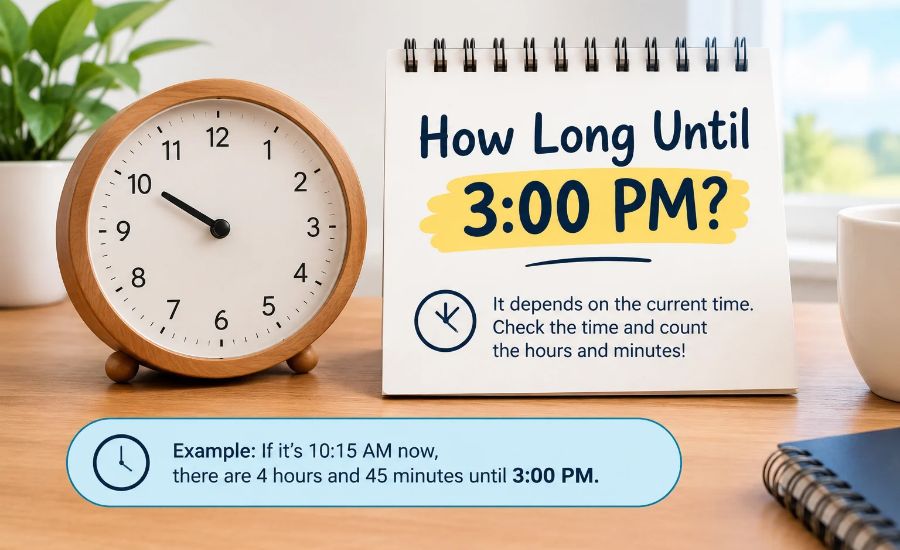
Figuring out what time is 10 hours from now is simple once you know the current time — just add 10 hours to it. Whether you’re tracking a flight, a work shift, a delivery window, or a countdown to an event, knowing the exact clock time ahead of you removes the guessworkThis guide explains the computation, provides an hour-by-hour breakdown, and addresses the most frequently asked topics that come up when someone searches for “10 hours from now.”
Read More: 6 Weeks From Today: The Exact Date and How to Make It Count
In ten hours, what time will it be?
To find the time 10 hours from now, take your current time and add 10 hours to it, adjusting for AM/PM and rolling over to the next day if needed. For example, if it’s currently 5:00 PM on Friday, October 3, 2026, adding 10 hours brings you to 3:00 AM on Saturday, October 4, 2026.
| Calculation Detail | Answer |
| Starting time | 5:00 PM, Friday, Oct 3, 2026 |
| Hours added | 10 hours |
| Resulting time | 3:00 AM, Saturday, Oct 4, 2026 |
| Day change | Rolls into the next day |
This example uses 5:00 PM as a reference point — just swap in your actual current time and follow the same steps below.
Ten hours is how many minutes and seconds?
Ten hours breaks down into smaller units easily:
| Time Unit | Equivalent to 10 Hours |
| Hours | 10 |
| Minutes | 600 |
| Seconds | 36,000 |
| Approximate days | 0.42 of a day |
Unlike weeks or months, hours convert cleanly without any calendar irregularities, which makes this one of the easiest time calculations to do by hand.
How to Manually Calculate 10 Hours From Now
You don’t need a special tool to work this out — here’s the simple process:
Step 1: Note your current time. For example, 5:00 PM.
Step 2: Add 10 hours directly. 5:00 PM + 10 hours = 3:00 AM.
Step 3: Check if it crosses midnight. Since 5:00 PM + 7 hours already reaches midnight (12:00 AM), the remaining 3 hours push you to 3:00 AM — meaning the date advances to the next day.
Step 4: Confirm AM/PM. Crossing midnight flips PM to AM, so double-check this step carefully, since it’s where most manual mistakes happen.
Ten hours from now, what time is it—AM or PM?
Whether the result lands in AM or PM depends entirely on your starting point:
| Starting Time | Time 10 Hours Later |
| 12:00 AM | 10:00 AM |
| 6:00 AM | 4:00 PM |
| 9:00 AM | 7:00 PM |
| 12:00 PM | 10:00 PM |
| 3:00 PM | 1:00 AM (next day) |
| 6:00 PM | 4:00 AM (next day) |
| 9:00 PM | 7:00 AM (next day) |
| 11:00 PM | 9:00 AM (next day) |
As a rule of thumb, any starting time of 2:00 PM or later will push you into the next calendar day once 10 hours are added.
Hourly Breakdown: 1 to 10 Hours From Now
If you want to track progress hour by hour instead of jumping straight to the 10-hour mark, here’s a full breakdown starting from 5:00 PM:
| Hours From Now | Resulting Time |
| 1 hour | 6:00 PM |
| 2 hours | 7:00 PM |
| 3 hours | 8:00 PM |
| 4 hours | 9:00 PM |
| 5 hours | 10:00 PM |
| 6 hours | 11:00 PM |
| 7 hours | 12:00 AM |
| 8 hours | 1:00 AM |
| 9 hours | 2:00 AM |
| 10 hours | 3:00 AM |
Countdowns, scheduling shifts, or just keeping track of how close you are to your goal time can all benefit from this table.
Is 10 Hours From Now the Same as Tomorrow?
Not always — it depends on what time it currently is. If it’s morning or early afternoon, 10 hours from now usually still falls on the same calendar day. If it’s evening or night, adding 10 hours almost always rolls into the next day. There’s no fixed answer; it’s entirely tied to your starting clock time.
Read More: 39 Weeks From Today: Here’s the Exact Date and What You Can Do With It
10 Hours From Now vs. 10 Hours Ago
These two phrases move in opposite directions on the clock:
| Time Expression | What It Means |
| 10 hours from now | 10 hours after the current time |
| 10 hours ahead | Same as “10 hours from now” |
| 10 hours ago | 10 hours before the current time |
| 10 hours before now | Same as “10 hours ago” |
| 600 minutes from now | Same as 10 hours from now |
Using the 5:00 PM reference point: 10 hours from now is 3:00 AM, while 10 hours ago would be 7:00 AM the same day.
Why People Search “10 Hours From Now”
Ten hours is a common unit of time because it closely matches real-world schedules like work shifts, flight durations, or sleep cycles. Common reasons people look this up include:
- Flight tracking — estimating landing time for a 10-hour flight
- Work shifts — calculating the end of a long shift
- Medication timing — tracking when the next dose is due
- Cooking or baking — slow-cooked meals or marinating times
- Fasting windows — tracking intermittent fasting schedules
- Deadlines — knowing the exact cutoff time for same-day tasks
- Sleep planning — figuring out wake-up time based on bedtime
- Time zone coordination — aligning with someone in a different region
- Gaming or streaming — countdown to an event or release
Because 10 hours often crosses into the next day, people search this specifically to avoid the mental math of tracking AM/PM changes.
Using 10 Hours From Now for Planning
Breaking a 10-hour window into smaller checkpoints can make it easier to stay on track, especially for tasks that unfold over several hours. For example, if you’re starting a project at 9:00 AM:
| Checkpoint | Time |
| Start | 9:00 AM |
| 2.5 hours in | 11:30 AM |
| 5 hours in (halfway) | 2:00 PM |
| 7.5 hours in | 4:30 PM |
| 10 hours (finish) | 7:00 PM |
Rather than only watching the final target time, checking in at these midpoints helps you gauge whether you’re on schedule.
Does 10 Hours From Now Account for Time Zones?
By default, “10 hours from now” assumes you’re staying in the same time zone. If you’re coordinating with someone across time zones, you’ll need to add 10 hours to your local time first, then convert that result to their time zone separately — doing both conversions at once often leads to errors.
FAQs
1. What time will it be in ten hours?
It depends on your current time. Add 10 hours to your starting time, adjusting for AM/PM and the next day if the total passes midnight.
2. How many minutes is 10 hours?
10 hours equals 600 minutes, or 36,000 seconds.
3. Does 10 hours from now always fall on the next day?
Not always. If your current time is before roughly 2:00 PM, 10 hours from now usually stays on the same day. If it’s later than that, it typically rolls into the next day.
4. Is 10 hours from now the same as 600 minutes from now?
Yes, both represent the same length of time, just expressed in different units.
5. How do I calculate 10 hours from now without a calculator?
Add 10 to your current hour. If the result passes 12, subtract 12 and flip AM to PM or PM to AM, and move to the next day if needed.
Final Thoughts
Knowing what time is 10 hours from now comes down to one simple step: add 10 hours to your current time and adjust for AM/PM changes. Since 10 hours is more than half a day, the result frequently lands on the following calendar day if you’re starting in the afternoon or evening. Whether you’re timing a flight, a shift, a meal, or a deadline, this quick calculation gives you a precise answer without needing any special tools.